-
DeutschDeutschland

-
EnglishWorldwide

-
Canada

-
Ireland

-
South Africa

-
United Kingdom

-
EspañolArgentina

-
Colombia

-
España

-
FrançaisFrance

-
Tunisie

-
Magyar nyelvMagyarország

-
NederlandsNederland
-
PolskiPolska

-
SuomiSuomi

ABO Energy and Copenhagen Infrastructure Partners (CIP) are jointly developing a large-scale wind and hydrogen project in Newfoundland and Labrador, harnessing the province’s world-class wind resources.
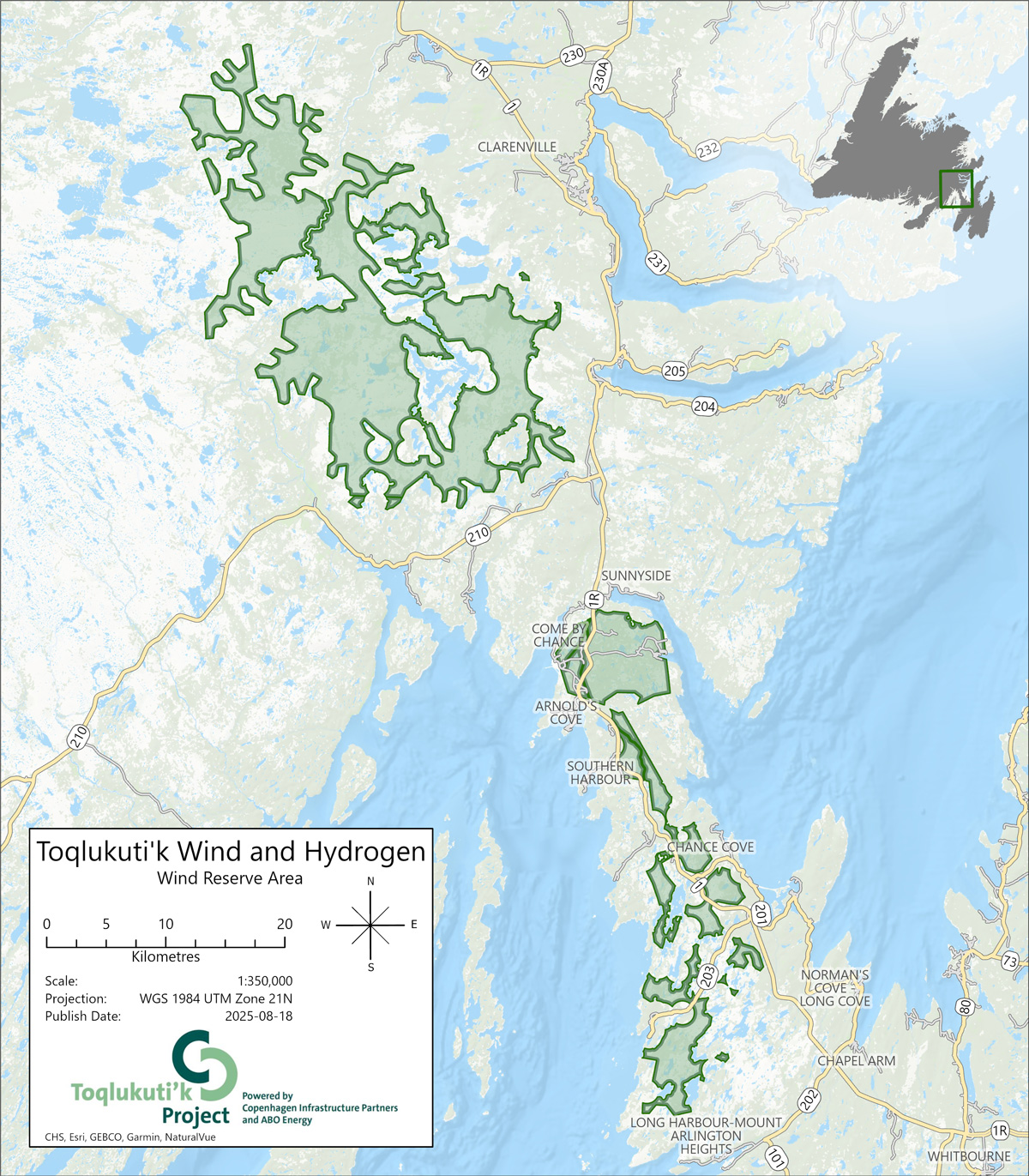
Located near the Isthmus of Avalon, the Toqlukuti’k Wind and Hydrogen Project aims to produce clean, green hydrogen and ammonia that can support both local energy needs and international markets.
With the potential to generate between 2.5 and 3.2 gigawatts of onshore wind power, the Project represents a significant opportunity for economic growth, local investment, and long-term benefits for communities in the region. ABO Energy and CIP are committed to working with local partners, including Indigenous communities, to shape the Project in a way that reflects community values, supports sustainability, and creates meaningful opportunities. At the same time, they will continue refining the technical design and capacity of the Project in alignment with evolving market demand.
Our new logo for the Toqlukuti’k Project is inspired by the spirit of collaboration at the heart of our work. The two interlocking C's symbolize the idea of "Toqlukuti’k", a Mi’kmaw word meaning “working together.” This connection reflects our commitment to partnership – with communities, with each other, and with the environment.
The circular motion of the C’s also mirrors the turning blades of wind turbines, capturing the movement and energy that power the Project. The two shades of green represent both green hydrogen – the clean molecule we aim to produce – and the broader renewable nature of the entire initiative.
Together, these elements reflect our vision of a greener future, built through cooperation and sustainable innovation.





The draft EIS Guidelines are now available and you can access them here. A 40-day public review and comment period is now underway, providing community members, organizations, and stakeholders the opportunity to share their input. All comments received will be considered before the final EIS guidelines are issued.
How can you participate?
Public comments are open until December 16, 2025, and your input matters. Send your feedback directly to the Department by email or mail:
Eric Watton, EAC Chair
Environmental Assessment Division
Department of Environment, Conservation and Climate Change
P.O. Box 87
St. John’s, NL A1B 4J6
The EIS will provide a more detailed understanding of how the Project could interact with the environment. The Environmental Assessment Committee has outlined what information must be included in this report. Once the guidelines are finalized, our team will develop and submit the EIS review. We’re committed to a transparent, community-driven process and will continue to share updates as we move through the EIS stage. Your feedback is an important part of shaping the future of Project Toqlukuti’k.
Please click here for the Expression of Interest (EOI) for electrical simulation studies in support of the Toqlukuti’k (TQK) Project.
We kindly ask you to confirm receipt of this communication by replying to info_toqlukutik@aboenergy.com. EOIs are to be submitted no later than Monday, October 6, 2025, by 5:00 pm NST.
Any questions regarding the process may be directed to the Proposal Contacts:
We appreciate your consideration and look forward to receiving your submission.
Please click here for the Expression of Interest (EOI) for the engineering, procurement, and construction of meteorological measurement towers (MET) in support of the Toqlukuti’k (TQK) Project. You can fill out our NDA here.
We kindly ask you to confirm receipt of this communication by replying to info_toqlukutik@aboenergy.com. EOIs are to be submitted no later than September 23, 2025.
Any questions regarding the process may be directed to the Proposal Contacts:
We appreciate your consideration and look forward to receiving your submission.
The Honourable Dr. Scott Reid, Minister of Environment and Climate Change, has announced that Project Toqlukuti’k will require an Environmental Impact Statement (EIS).
An Environmental Assessment Committee has been appointed to provide scientific and technical advice to the Minister and to develop draft guidelines to assist the Project Toqlukuti’k team in preparing the EIS.
The public will also be invited to comment on the draft guidelines once released.
You can access the Minister’s letter here.
The Environmental Assessment Registration (EAR) for Project Toqlukuti’k has now been officially submitted to the Government of Newfoundland and Labrador. The name under which the Project is registered is “Toqlukuti’k Avalon Isthmus Green Energy Project”.
As part of the provincial Environmental Assessment process, the public is invited to review and provide comments on the EAR submission. This is a key milestone in the development of the Project and an important opportunity for community and stakeholder input.
Public Comment Period is Now Open
In your submission, please include the following:
We appreciate your continued interest in the Project and encourage you to take part in this phase of the process. Your feedback is valuable in helping us advance Project Toqlukuti’k in a transparent, and responsible way.
Please find our Expression of Interest (EOI) for a Geotechnical and Hydrological* Assessment in support of the Toqlukuti’k (TQK) Project here. TQK is preparing to issue a Request for Proposal (RFP) and is looking for future submissions of proposals from qualified Vendors, to carry out studies regarding the Geotechnical and Hydrological Assessments in the Project Area and complementary field studies.
Interested vendors are asked to have an executed NDA with TQK. If you do not have one yet, here is the template you need to submit with the EOI.
Any questions regarding the process should be addressed to the Proposal Contacts (Ilkay.Taskin@aboenergy.com, Michael.Haag@aboenergy.com, Ben.Gerrior@aboenergy.com). EOIs are expected to be received by electronic mail, addressed to the Proposal Contacts, no later than July 16th, 2025 at 5:00 p.m. CEST (EOI Submission Deadline).
Thank you for your continued support and collaboration.
*Vendors may submit proposals solely for the Geotechnical Assessment.
Please find our Expression of Interest (EOI) for Regulatory Services on behalf of the Toqlukuti'k Wind & Hydrogen Project here. The submission deadline is Wednesday, May 7, 2025.
There is no formal format of the Response. The purpose of this EOI is to be an Open Invitation to confirm if companies have the required technical experience, qualifications, and corporate HSE/Insurance requirements to further support Project Toqlukuti’k and thus would qualify for receipt of upcoming RFP.
If you have submitted a bid to ABO Energy Canada Ltd or Project Toqlukuti’k in the last three years, your company will automatically be considered qualified for the RFP; however, we still require company’s confirmation in receiving the RFP. Please indicate as per Appendix A.
Successful Bidders invited to the RFP will be asked to execute an NDA which you can find here.
We appreciate your consideration and look forward to receiving your submission.
Please find our Expression of Interest (EOI) for the provision of engineering services in support of the Toqlukuti’k (TQK) Project here. This includes desktop studies regarding the availability of surficial freshwater in the area of the Project and recommended complementary field studies.
Interested vendors are asked to have an executed NDA with TQK. If you do not have one yet, here is the template you need to submit with the EOI.
Any questions regarding the process should be addressed to the Proposal Contacts, Federico Constantin (federico.constantin@aboenergy.com) and Itxaso Schott (itxaso.schott@aboenergy.com).
Thank you for your continued support and collaboration.
From May 5–7 the Project Toqlukuti’k team hit the road, visiting communities in the Isthmus of Avalon to reconnect, share updates, and hear what matters most. At each Open House, we walked through where the Project began, how it has evolved, and what’s coming next. Attendees explored maps and poster boards, joined conversations with our team, and asked important questions—from cabin access and fire safety to job creation, community benefits, wildlife protection and so much more. We’re grateful to everyone who took the time to join us. Your input—your stories, concerns, and recommendations—are shaping how this Project moves forward. And we’re not done yet. The next steps include submitting the Environmental Assessment, continuing field studies, further community engagement, and working through regulatory approvals—with ongoing opportunities for public input. We’ll continue to share updates and invite feedback as the Project progresses—thank you for being part of the process.
Click here to view our presentation >
Click here to view our posterboards >
Coming soon: A new “What We Heard” summary capturing key themes from your feedback.
Let’s keep the conversation going – contact us or subscribe to our newsletter today!
ABO Energy enters partnership with CIP to jointly pursue Canadian Wind and Hydrogen Project >
Thank you to everyone who joined us at our seven open houses in March 2024!
We appreciated the thoughtful questions, feedback, and conversations about the Toqlukuti’k Wind and Hydrogen Project.
To reflect what we heard, we’ve prepared a summary report capturing key themes, questions, and comments from the sessions. While some questions couldn’t be answered yet due to the early stage of the Project, we’re committed to providing updates as more details become available.
Click here the What We Heard report.
With our third-party environmental consultant, ABO Energy is continuing environmental baseline studies throughout the spring and summer. Baseline studies help us determine and understand the characteristics of an area prior to any development, and to establish the existing environmental status.
By continuing these studies, we will be able to assess, verify and compile valuable environmental and ecological data to support the development of the environmental assessment registration document (EAR). The requirements for baseline assessment studies have been identified per the guidelines provided by the Government of Newfoundland and Labrador’s Department of Environment and Climate Change.
What to expect:
Timeframe:
April to September 2024
As mentioned in the recent information session presentations, ABO Energy will be installing a MET tower to measure wind. A third-party contractor (TEP) and their subcontractor (Westower Communications) will conduct the first installation of a MET tower.
What is a MET? A MET tower, short for “meteorological evaluation tower” is a wind measurement tower to verify wind speeds in certain locations. It looks like many cellphone towers that are already installed throughout the region.
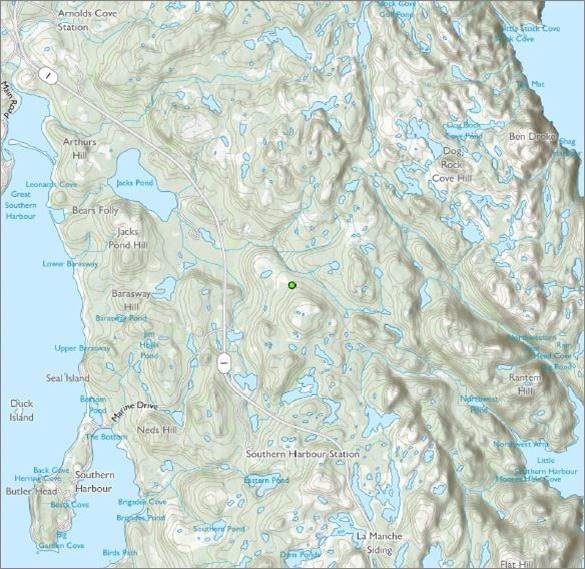
Where is it being installed? The MET will be installed in the hills North of Southern Harbour and Southern Harbour Station, on the East side of the TCH. This location is indicated by the green dot on the map below.
Why is it being installed? This measurement activity will help inform the Toqlukuti’k Wind and Hydrogen Project as it comes to expected wind speeds for planning wind turbine installations. It will also support the wind feasibility scope of the Project’s Environmental Assessment Registration. There will be additional MET installations as the Project planning progresses.
What to expect for this installation activity?
Questions?
Contact Joe Bennett, Communications and Engagement Lead, Toqlukuti’k Wind and Hydrogen
joe.bennett@aboenergy.com
709-219-8707
MET Location Map:
Starting in April, our team will hold monthly visits to communities near the Project area.
These drop-in sessions are designed to share updates, answer questions, and hear feedback from residents. They’re not formal meetings or presentations – just a chance for community members to connect directly with the Project team.
We’re committed to open, transparent communication and want to ensure everyone can be heard. As with any office environment, we ask that all conversations remain respectful and constructive. See the schedule below to find out when we’ll be in your area:
| AM | PM | Evening | |
| April 16 | Chance Cove Community Centre | Southern Harbour Community Centre | |
| April 17 | Come By Chance Town Hall | Arnold’s Cove Community Centre | Bull Arm Visitors Centre |
| April 18 | Sunnyside Recreation Centre | CNA Clarenville Campus | |
| May 21 | Chance Cove Community Centre | Southern Harbour Community Centre | |
| May 22 | Come By Chance Town Hall | Arnold’s Cove Community Centre | Bull Arm Visitors Centre |
| May 23 | Sunnyside Recreation Centre | CNA Clarenville Campus | |
| June 18 | Chance Cove Community Centre | Southern Harbour Community Centre | |
| June 19 | Come By Chance Town Hall | Arnold’s Cove Community Centre | Bull Arm Visitors Centre |
| June 20 | Sunnyside Recreation Centre | CNA Clarenville Campus | |
| July 16 | Chance Cove Community Centre | Southern Harbour Community Centre | |
| July 17 | Come By Chance Town Hall | Arnold’s Cove Community Centre | Bull Arm Visitors Centre |
| July 18 | Sunnyside Recreation Centre | CNA Clarenville Campus | |
| August 20 | Chance Cove Community Centre | Southern Harbour Community Centre | |
| August 21 | Come By Chance Town Hall | Arnold’s Cove Community Centre | Bull Arm Visitors Centre |
| August 22 | Sunnyside Recreation Centre | CNA Clarenville Campus | |
| Sept 17 | Chance Cove Community Centre | Southern Harbour Community Centre | |
| Sept 18 | Come By Chance Town Hall | Arnold’s Cove Community Centre | Bull Arm Visitors Centre [CANCELLED] |
| Sept 19 | Sunnyside Recreation Centre | CNA Clarenville Campus | |
| Oct 22 | Chance Cove Community Centre | Southern Harbour Community Centre | |
| Oct 23 | Come By Chance Town Hall | Arnold’s Cove Community Centre | Bull Arm Visitors Centre |
| Oct 24 | Sunnyside Recreation Centre | CNA Clarenville Campus |
Thank you to everyone who joined us at one of our seven community information sessions in March 2024. We appreciated the opportunity to connect with so many residents across the region and hear your thoughts, questions, and concerns about the Toqlukuti’k Wind and Hydrogen Project.
Our team is currently updating our Frequently Asked Questions and preparing a summary document that highlights the key themes and feedback shared during the sessions.
Community input plays a vital role in shaping our Project. We’re committed to continuing this dialogue—through regular drop-in office hours, ongoing outreach across the region, and meetings with key stakeholders throughout the summer.
Looking ahead, we’re also planning additional community information sessions this fall to share updates on the Project, including environmental study findings and further opportunities for collaboration.
Missed the March sessions or want to revisit the materials? Click here to view the information shared.
ABO Wind eager to commence Toqlukuti’k Wind and Hydrogen Project in NL (pdf)
Stay updated on Toqlukuti'k Wind and Hydrogen by subscribing to our e-newsletter here.
Previous editions:
In August 2023, the Toqlukuti’k Wind and Hydrogen Project was one of four in Newfoundland and Labrador to receive a Wind Application Recommendation Letter from the Minister of Industry, Energy and Technology. This letter grants the Project the exclusive right to pursue development on nominated Crown lands.
ABO Energy also received an exclusive letter of support from Braya, confirming a joint commitment to develop green hydrogen production at the Come By Chance refinery.
As part of its Crown land bid, the Project signed a memorandum of understanding (MOU) with Miawpukek First Nation and has received numerous letters of support from surrounding communities.
The name Toqlukuti’k (pronounced dok-loo-gu-tik) was chosen in partnership with Miawpukek First Nation and comes from the traditional Mi’kmaq language. It means “working together”—a reflection of the collaboration at the heart of the Project.
Toqlukuti’k is expected to create meaningful local economic and employment opportunities as it moves forward.
Project Evolution
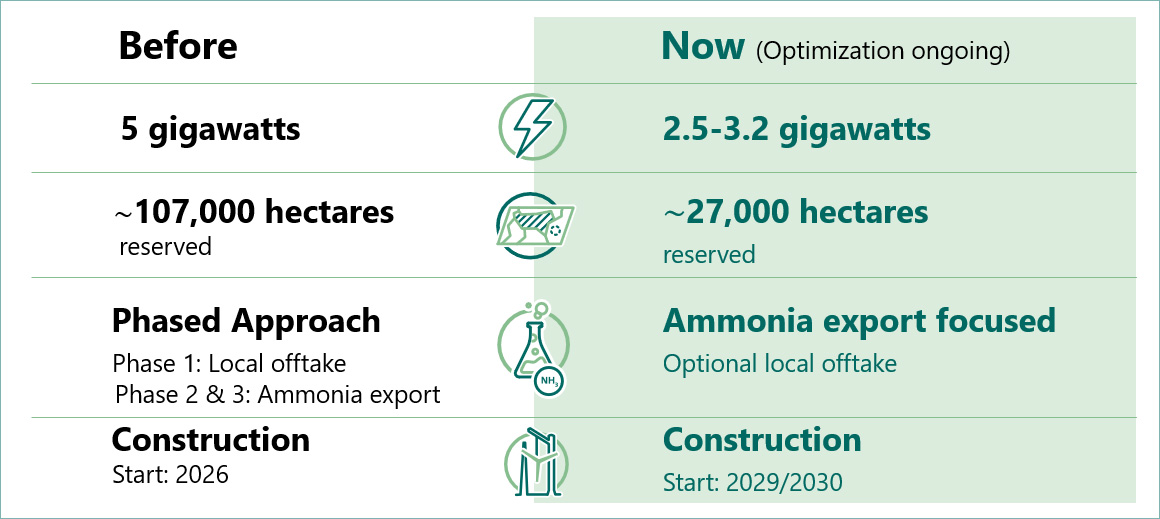
Project Toqlukuti’k is evolving—we’ve refined the scope and adjusted our timeline to better align with global market trends.
Disclaimer:
All changes to the Project must be approved by the Department of IET. At this time, our request to reduce the land reserve by 50% has been approved. We are actively working with the government to further modify the Project, including reducing its size from a 5 GW wind Project to approximately 2.5-3.2 GW, as well as further decreasing the land area required through the Crown Land application process.
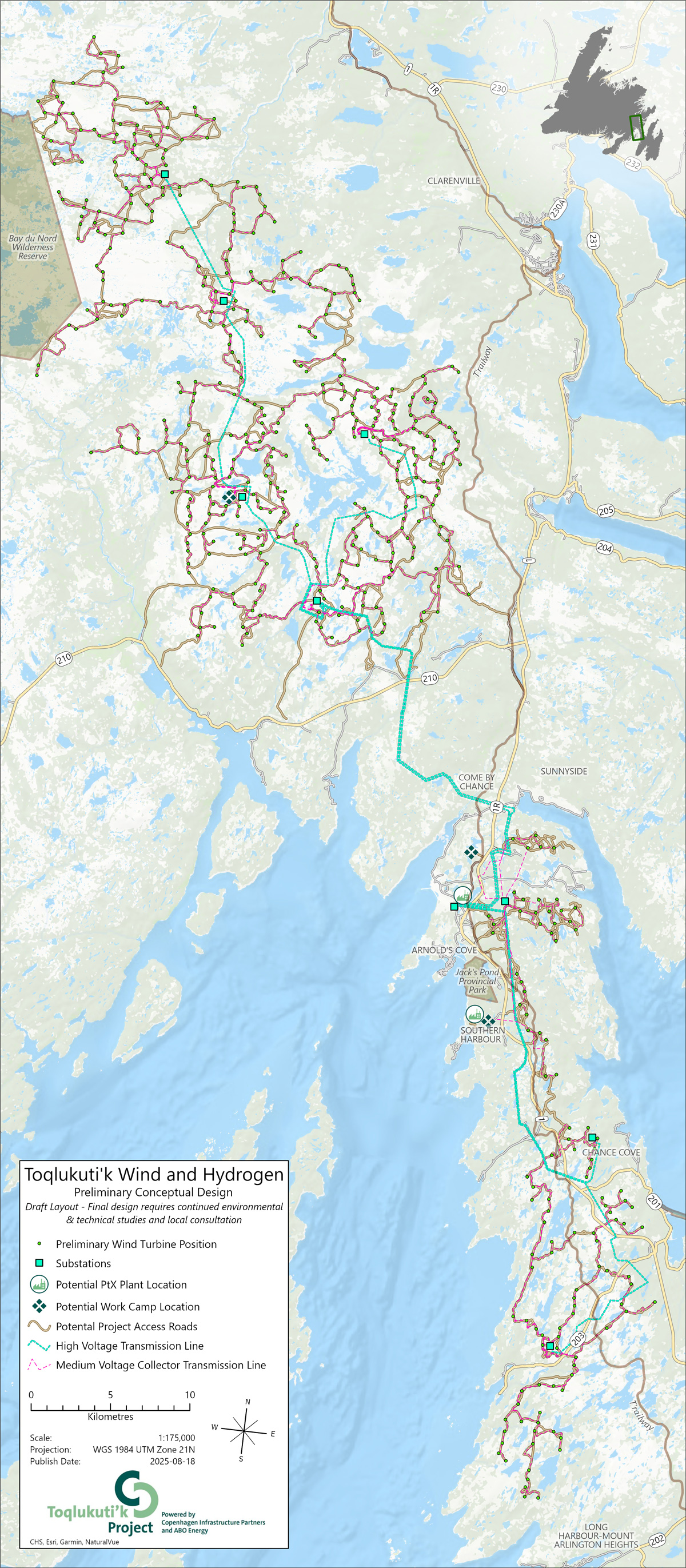
Site Location
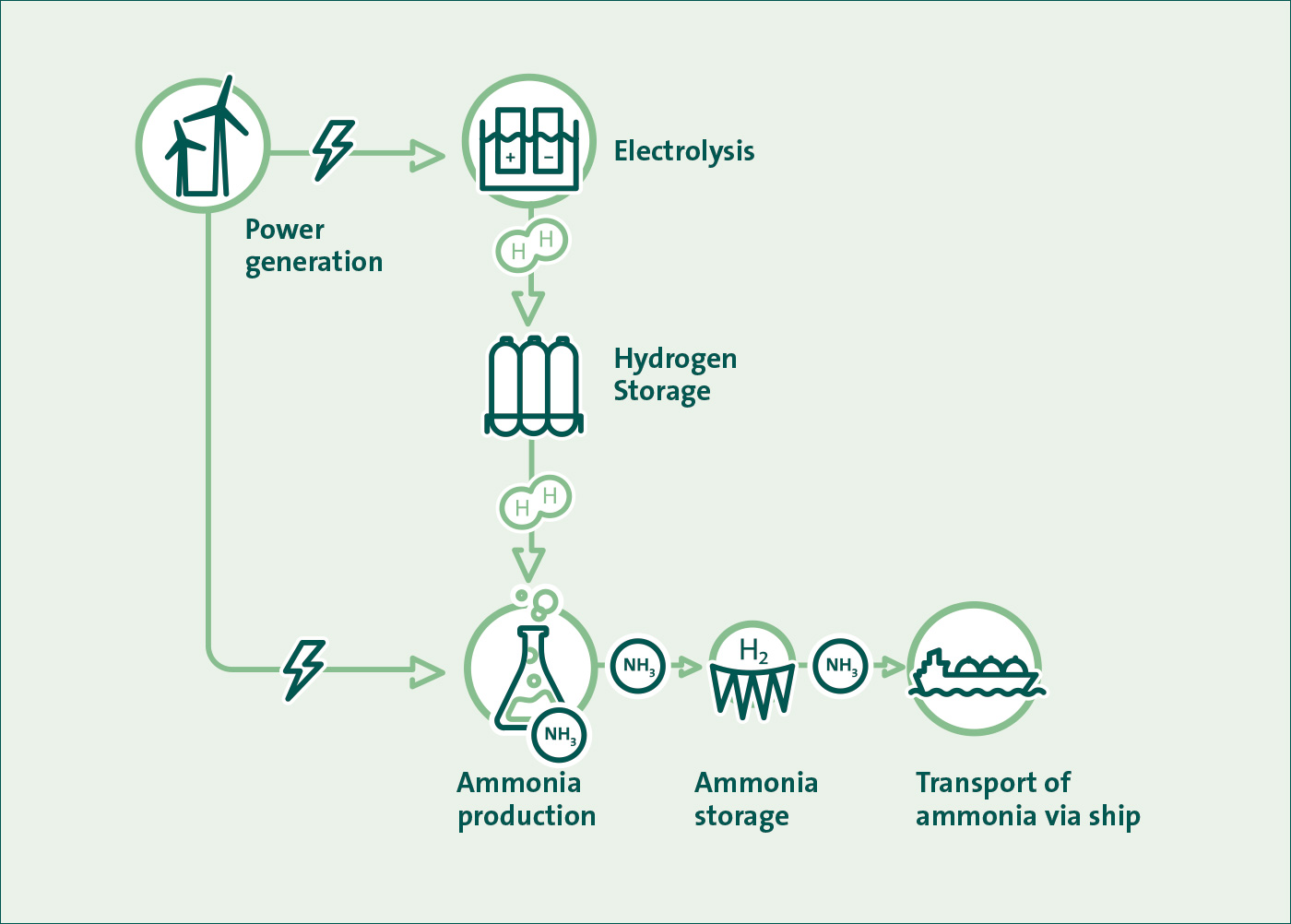
From Wind to Fuel: How the Project Works
Unlike typical wind farms that send electricity directly to the power grid, the purpose of Project Toqlukuti’k is different. Our wind turbines will generate clean, renewable electricity to power an electrolyzer facility – which uses water and wind power to produce clean hydrogen, and ultimately, green ammonia for export.
ABO Energy, formerly known as ABO Wind, successfully develops and builds wind and solar farms as well as battery storage and hydrogen projects. Founded in 1996, the Germany-based company has realised 6,4 gigawatts of renewable energy capacity to date and has built around half of them. The annual investment amounts to one billion euros. More than 1,400 employees on four continents work with enthusiasm on the development, planning, financing, construction, operational management, and maintenance of plants for a sustainable energy supply.
ABO Energy Canada was founded in 2017, with offices in Calgary, Toronto, Halifax, and St. John’s. At ABO Energy, renewables are our DNA.
In December 2024, ABO Energy welcomed Copenhagen Infrastructure Partners (CIP) as the majority investor in the Toqlukuti’k Wind and Hydrogen Project, transferring a 90% ownership share to the firm. CIP is the world’s largest dedicated fund manager within greenfield energy investments. As a global leader in energy development, CIP brings a deep portfolio of international experience, particularly in large-scale ammonia and hydrogen projects. From the outset, ABO Energy envisioned the Toqlukuti’k Project as a collaborative effort. Given the scale and complexity of the project, bringing in a strategic partner like CIP was a natural and essential step. CIP’s involvement strengthens the project’s foundation and supports its long-term success through their technical, financial, and operational expertise in energy infrastructure.
The success of the Toqlukuti’k Project depends on meaningful input from Indigenous and local communities. We are committed to open, honest dialogue and will continue to build respectful relationships throughout every phase of the project lifecycle.
Working with Indigenous Communities
Toqlukuti’k Wind and Hydrogen is being developed in close collaboration with Indigenous stakeholders. Since 2022, we’ve been actively engaging with Miawpukek First Nation (MFN) through regular meetings, in-person visits, and knowledge sharing, including a joint presentation at an Atlantic Indigenous conference. Together, we are developing a formal Consultation and Engagement Plan to guide our work moving forward.
We also began engagement with Qalipu First Nation in 2023. We’ve held formal meetings to share project updates and explore collaboration. Qalipu has offered valuable input on the environmental assessment process, and we are committed to maintaining regular dialogue and involvement through future engagement activities.
These relationships are built on shared values—respect for the environment, support for local opportunities, and a commitment to long-term collaboration.
Supporting Local Opportunities & Economic Impact
Community Liaison Committee (CLC)
Prior to construction we’ll be forming the Toqlukuti’k Community Liaison Committee (CLC)—a volunteer advisory group that helps ensure community voices are heard.
The CLC will:
If you’re interested in joining, please email info_toqlukutik@aboenergy.com with a short introduction and why you'd like to be involved.
Project and Purpose
ABO Energy and Copenhagen Infrastructure Partners (CIP) are jointly developing a large-scale wind and hydrogen project in Newfoundland and Labrador, harnessing the province’s world-class wind resources.
Located near the Isthmus of Avalon, the Toqlukuti’k Wind and Hydrogen Project aims to produce clean, green hydrogen and ammonia that can support both local energy needs and international markets
With the potential to generate between 2.5 and 3.2 gigawatts of onshore wind power, the project represents a significant opportunity for economic growth, local investment, and long-term benefits for communities in the region. ABO Energy and CIP are committed to working with local partners, including Indigenous communities, to shape the project in a way that reflects community values, supports sustainability, and creates meaningful opportunities. At the same time, they will continue refining the technical design and capacity of the project in alignment with evolving market demand.
There is a variety of key components that the Project infrastructure could include, broken down into the Wind and Hydrogen facilities. Infrastructure associated with the Hydrogen Facility would be located on-site or within close proximity to the existing Come By Chance refinery. Infrastructure associated with the Wind Farm would be located on Crown Lands in the Isthmus region.
Hydrogen Facilities
Wind Facilities
The Project secured Crown land through the Government of Newfoundland and Labrador’s Crown Land Call for Bids for Wind Energy Projects. Newfoundland and Labrador offers world-class wind resources, deep-water ports, skilled labour, and a strategic location close to Europe. With strong, consistent winds and abundant available land, advantages not always found in more densely populated regions, Newfoundland and Labrador is well positioned to compete in the global green hydrogen market, as recognized in the Canada-Germany Hydrogen Alliance.
While this is the first project of its kind in NL, Project Toqlukuti’k brings international experience from similar environments and is committed to a careful, step-by-step approach: conducting detailed environmental studies, drawing on local expertise, and listening to community input.
The lifecycle of a wind turbine is typically 20-30 years with the possibility of an extension through repowering. The expected life of a hydrogen electrolyzer’s stack components is 50-60 years before requiring replacement. These stacks would be replaced consistently throughout the life of the rest of the project.
Construction, Timeline, Suppliers and Labour
Pending regulatory approval, the Project is currently expected to begin construction in 2029 or 2030. Full build-out is expected to take approximately 4 to 5 years, though this may vary.
If you are a vendor interested in providing your goods and/or services to Project Toqlukuti’k we ask that you submit your company information via our ‘Supplier Registration Form’ located here (portal link is also accessible by scrolling to the bottom of this webpage). Additional questions related to supplier opportunities with Project Toqlukuti’k can be directed to info_toqlukutik@aboenergy.com.
Project Toqlukuti’k believes that communities in proximity to our Project should receive preferential attention and access to business and employment opportunities. We have already begun work with local service providers.
We are guided by our Local Economic Development Policy to provide full and fair opportunity to the local labour force and vendors and suppliers. It is our intent to maximize economic benefits for communities and their residents and promote long-term commercial growth through access to goods and service contracts, capacity training, and employment.
Local experience and knowledge are also a key component of our supplier selection criteria, and this criteria will be employed in all future Requests for Proposals related to this Project.
Project Toqlukuti’k has had an office in St. John’s since 2023 with local staff in place. Our team also visits surrounding communities in the project area to share updates and stay connected with residents.
Outside of the core Project development teams of ABO Energy and CIP, TQK does not hire individuals directly—we hire companies who then staff their own teams. We will be issuing Requests for Proposals (RFPs) during development for different scopes of work. To be notified of these opportunities, please register on our Vendor and Supplier Portal (Toqlukuti’k Wind and Hydrogen Project) to keep updated.
At peak construction, we estimate approximately 4,600 jobs, and 500 jobs during operations. Specialized programs like the Wind Turbine Technician and Hydrogen Technician programs at College of the North Atlantic can help prepare local workers. However, there will be many types of trades involved in construction, like any large land-based industrial project.
Communities
To date Project Toqlukuti’k team members have visited the area on many occasions to connect with and developed relationships with area residents, various stakeholders including local municipal councils, organizations such as local Chambers of Commerce, industry organizations such as econext and Energy NL, local tourism operators, and local not-for-profits.
Project Toqlukuti’k is continuing to build relationships, listen to feedback and remain transparent through further meetings, information sessions, and through a Community Liaison Committee. Project Toqlukuti’k is committed to ongoing engagement and sharing up-to-date information with stakeholders and local communities through the life of the Project.
Project Toqlukuti’k is committed to transparent, meaningful, and ongoing Indigenous engagement and has signed a memorandum of understanding (MOU) with Miawpukek First Nation.
Project Toqlukuti’k welcomes all feedback on the Project. These communications should be directed to info_toqlukutik@aboenergy.com.
Guided by our Local Economic Development Policy, Project Toqlukuti’k is committed to providing equitable opportunities for local labour, businesses, and suppliers. It is Project Toqlukuti’k’s intent to maximize economic benefits for communities and their residents and promote long-term commercial growth through access to goods and service contracts, capacity training, and employment.
Project Toqlukuti’k is proud to support local communities, non-profit organizations, and industry associations through various donations and sponsorships, and looks forward to building on these community investment opportunities in the region.
Environment
Like all major infrastructure projects in Newfoundland and Labrador, Project Toqlukuti’k is subject to an environmental assessment process. The Project has engaged a local environmental consultant and has officially submitted its Environmental Assessment Registration (EAR) to the Government of Newfoundland and Labrador.
The Project is registered under the name “Toqlukuti’k Avalon Isthmus Green Energy Project.” The full EAR is available online at Toqlukuti’k Avalon Isthmus Green Energy Project – Environment and Climate Change.
We continue to work closely with the Department of Environment and Climate Change to identify and mitigate potential environmental impacts.
A range of desktop studies have already been conducted across all areas of interest, and field studies began in June 2023.
Conducted field studies: aquatics, bats, shorebirds, breeding birds, and waterfowl.
Upcoming studies: water resources, additional aquatics, ecological land classification, rare plants and lichens.
The Environmental Assessment Registration (EAR) for Project Toqlukuti’k has now been officially submitted to the Government of Newfoundland and Labrador. The name under which the Project is registered is “Toqlukuti’k Avalon Isthmus Green Energy Project. The EAR is available online at: Toqlukuti’k Avalon Isthmus Green Energy Project - Environment and Climate Change
Most currently (September 12, 2025), the Honourable Dr. Scott Reid, Minister of Environment and Climate Change, has announced that Project Toqlukuti’k will require an Environmental Impact Statement (EIS). An Environmental Assessment Committee has been appointed to provide scientific and technical advice to the Minister and to develop draft guidelines to assist the Project Toqlukuti’k team in preparing the EIS.
The public will also be invited to comment on the draft guidelines once released.
You can access the Minister’s letter here.
As part of the site selection process, Project Toqlukuti’k completed a comprehensive environmental constraints analysis to minimize potential impacts on local wildlife. Robust environmental studies will be completed during the Environmental Assessment process to develop an understanding of habitat conditions as well as the birds and wildlife utilizing the site. Results of the studies will be used to develop innovative and effective mitigation strategies specific for the local area and wildlife. We will work closely with our environmental consultants and regulators throughout the Environmental Assessment process to reduce impact on the local environment.
We encourage you to visit the Environmental Assessment page on the Government of Newfoundland and Labrador’s website. It outlines the purpose of the EA, explains how the process works, and provides contact information and other resources. You can access it here: Environmental Assessment - Environment and Climate Change
Wind Turbines
While the final turbine model hasn’t been selected yet, here’s how it may look:
In the absence of existing provincial regulations, we will follow best practices for noise regulations from other regions in Canada. We will strive to remain below 40dB as required in other provinces. Wind turbines generate noise at a level between 35-45 dB or as noted above equivalent to a quiet whisper. Modern wind turbines are much quieter than 1st generation turbines of 20 years ago.
Our project is strictly onshore wind. There will be no offshore wind turbines.
An approximately 5-meter-wide access road is maintained for the life of the project. An approximately 12-meter-wide access road would be used for the construction phase and restored to a 5-meter-wide access road for the life of the Project.
Wind turbines have a very small physical footprint. Much of the foundation is buried underground, and once installed, they occupy minimal space above. A typical foundation of a state-of-the-art wind turbine is approximately 27m in diameter whereas the tower itself has a diameter of approximately 5m dependent on the final wind turbine type selected.
We respect that some individuals may have concerns regarding health. The Project will be designed to meet or exceed all provincial regulations and guidelines currently in place to protect human health.
Health Canada with Statistics Canada and other external experts conducted a Community Noise and Health Study. The results released in 2014 indicated that wind turbine noise was not linked to self-reported medical illnesses and health conditions.
When it comes to the end of life for a wind project there are two options: decommissioning and repowering.
Repowering: The ability to repower a site hinges on a few key considerations, such as the health of the foundations and other components on the site, the economics of the power being generated at the site, and the new technology available. Repowering a site prolongs the life of the project and helps to postpone the need for new project development (Canadian Renewable Energy Association, 2023).
Decommissioning: Due to economics, regular wear and tear or other factors, it may be necessary to remove the project and return the land to its equivalent original state. Decommissioning consists of dismantling the site by extracting the recyclable materials like steel, concrete and glass, and properly disposing of any other components in compliance with local requirements (Canadian Renewable Energy Association, 2023).
Wind Turbines: The main components of a wind turbine that can be recycled, repurposed, or salvaged include: Steel tower sections, steel reinforcement, electrical equipment and cables, precious metals, and concrete. Other materials or pieces of equipment that cannot be recycled, repurposed or salvaged will be disposed of according to local/provincial regulations.
Green Hydrogen Facility and Export
Hydrogen itself is a colourless gas. The term clean hydrogen is preferred, as it describes hydrogen produced in a sustainable way. Clean hydrogen is made by splitting water molecules (H₂O) in a process called electrolysis, using an electrolyzer. To be considered “clean,” the electricity used must come from renewable sources. This ensures that no carbon dioxide (CO₂) or other harmful byproducts are released during production.
Clean hydrogen is central to Europe’s climate goals and long-term energy security. It is carbon-free, can be stored for long periods, and is highly versatile in its uses. When converted into derivatives such as ammonia, it can be exported globally and used across industries — from power generation and heating to transportation and manufacturing.
It is possible to transport hydrogen as a compressed gas or liquid. However, compared to hydrogen, ammonia has several decisive advantages in terms of long-distance transport. Characteristics including high energy density and ease of liquefaction allow it to be used in existing plants, transportation, and terminal facilities. Furthermore, if needed, ammonia can be converted to pure hydrogen on demand on the import side, without carbon emissions. Moreover, it has already been produced on a large-scale industrial application; therefore, handling and transport of ammonia is well known.
What We Heard: Community Questions and Answers
A device that uses electricity to split water molecules into seperate hydrogen and oxygen molecules through a process called electrolysis.
Hydrogen that is produced through the use of carbon-based energy sources such as natural gas through a process called steam methane reforming, without carbon capture and storage.
Hydrogen that is produced through the use of carbon-based energy sources such as natural gas through a process called steam methane reforming, with carbon capture and storage.
If you are a Vendor interested in providing your goods and/or services to Project Toqlukuti’k we ask that you submit your company information via our ‘Supplier Registration Form’ located here: