-
DeutschDeutschland

-
EnglishWorldwide

-
Canada

-
Ireland

-
South Africa

-
United Kingdom

-
EspañolArgentina

-
Colombia

-
España

-
FrançaisFrance

-
Tunisie

-
Magyar nyelvMagyarország

-
NederlandsNederland
-
PolskiPolska

-
SuomiSuomi

ABO Energy Canada is developing the Melvin Lake Wind project in response to Nova Scotia’s Clean Power Plan—reducing our reliance on coal, producing clean, low-cost energy to fight climate change.
We look forward to sharing updates with you regarding the next steps for this Project, including timelines, additional engagement, and upcoming local opportunities. Our Project website will continue to be updated with new information as development progresses.





We are pleased to share that development of the proposed Melvin Lake Wind Project continues to move forward. The Project remains well positioned to deliver clean, renewable electricity and long-term benefits for the local area and for Nova Scotia. We have several updates to share with you:
Upcoming Provincial Onshore Wind Procurement
Nova Scotia continues to require additional renewable energy and procures onshore wind through a competitive process known as the Green Choice Program. To advance toward construction and operation, projects must be successful in this procurement, alongside meeting other regulatory requirements.
The Green Choice Program website is now live, which provides a general expected timeline for the 2026 procurement: www.nova-scotia-gcp.com. Power Advisory LLC has been engaged by the NS Department of Energy to administer this procurement.
What this Means for the Project
We anticipate the Project will be submitted into the upcoming Green Choice Program procurement per their current deadline in early 2027. The Project is being advanced through a collaborative approach that includes an investor and First Nations partner(s).
While timelines remain subject to change, view the expected schedule of the procurement here.
Community and First Nations engagement will continue throughout this process, including future open houses, mailouts, and opportunities for feedback.
Project Community Liaison Committee (CLC)
Thank you for those who have already participated in the Project’s volunteer Community Liaison Committee (CLC) in past – we will be in touch with you when we are looking to plan our first meeting this year. We’re still welcoming additional volunteers to share input, community perspectives, and guidance to help shape the Project. Once up and running again, the CLC will meet regularly to discuss project plans, identify issues, and explore solutions.
We appreciate your interest in the Project and value your input as development progresses. Please do not hesitate to reach out if you have any questions, would like to inquire about our CLC, or to share feedback.
ABO Energy remains fully committed to the Melvin Lake Wind Project and continues to advance planning and engagement activities, including planning additional community open houses in 2026 (dates to be confirmed).
Earlier this year, the project was one of six projects selected through Nova Scotia’s Green Choice Program. As part of this process, each selected project was required to sign a 25-year Power Purchase Agreement with Nova Scotia Power Inc. ABO Energy declined to sign the Power Purchase Agreement (PPA) due to external economic conditions and current market realities. In fact, only two of six selected projects proceeded to sign the PPA offered.
This decision adjusts our development timeline, with construction now anticipated in 2027/2028 and operation in 2029/2030, pending success in the next onshore wind procurement round. We anticipate the next provincial procurement process to be announced in 2026 and plan to submit the project into this competitive process once again. We are continuing our planning and engagement to be ready for the next procurement. The province’s need for additional renewable energy remains clear, with significant additional wind capacity required by 2030 and 2035. Our project remains well positioned to deliver this reliable, affordable clean power and provide lasting community benefits for the local area and Nova Scotia.
We look forward to keeping you informed as development progresses and welcome your questions or feedback at any time.
The Project recently achieved a significant milestone with an Environmental Assessment approval on January 27, 2025.
The Project team looks forward to sharing updates with you regarding the next steps for Melvin Lake Wind including timelines, additional engagement, and upcoming local opportunities. Our Project website will continue to be updated with new information as development progresses (www.melvinlakewind.ca).
Thank you to all who came out to attend the July 2023 Melvin Lake Wind information session, hosted by the ABO Wind Canada team in Lewis Lake. We value your feedback and local knowledge, and remain committed to transparent, meaningful, and ongoing community and stakeholder engagement.
ABO Wind will be hosting additional information sessions in the spring to discuss important 2024 updates for the Melvin Lake Project with you.
We hope you will stop by to meet our team and learn more about the Melvin Lake Wind Project:
Session 1:
Monday, April 15, 2024
6pm - 8:30pm
Safety Minded ATV Association Clubhouse
15 Station Rd, Head Of St Margarets Bay (just off Hwy #3)
Session 2:
Tuesday, April 16, 2024
6pm - 8:30pm
Uniacke and District Fire Hall
654 Hwy #1, Mount Uniacke, NS B0N 1Z0
We are glad that you are visiting our website. We hope to answer any questions that you may have and encourage you to get in touch. If you have questions about the project, please contact Heidi Kirby of ABO Wind.
Please find the Open House Posters from the April Sessions here.
Now, up to 20 wind turbines would be placed on private land, just south of Highway 101 and west of Pockwock Lake, in East Hants and Halifax Regional Municipality, where we have permission of the landowner. This renewable energy project would produce an estimated 115.5 megawatts of green power –enough to power more than 25,000 homes annually!
The Green Choice program has a new requirement to build on private land only, so we are no longer utilizing Crown lands. With new private land leases in the area, we have been able to add several additional turbines to produce more clean, renewable energy for our province. We are hopeful this new layout is accepted positively by the community, and we look forward to hearing your feedback as we prepare to submit our Project into this procurement round in June 2024.
Additional environmental studies are ongoing to help inform ABO Wind’s Environmental Assessment Registration, a required component to proceed with Project construction.
New Map: Melvin Lake Wind
20 turbines, producing 115.5 megawatts of clean energy
The new layout is expected to use approximately 70% existing roads, with a percentage of these requiring upgrades to ensure safe access and sufficient widening for equipment association with wind turbine installation.
We also are still inviting interested individuals to join the Melvin Lake Wind Community Liaison Committee (CLC). CLC Members will meet periodically and will have a regular opportunity to share input, guidance, community views, and concerns to help inform the Project plan and related activities.
ABO Wind strongly encourages the public to participate in the Project planning process, issue identification, and problem solving.
Do you have general Project questions, or interest in joining the CLC? Please reach out to Heidi Kirby.
ABO Wind is conducting public engagement during the summer and fall as we prepare to submit the Rhodena Wind Project for Nova Scotia’s Green Choice Program later this year. Updates on the Project will be shared on this website.
We are mailing an update to households in communities close to the project.
ABO Wind has received word that the Melvin Lake Wind Project was not selected for the short list of the Nova Scotia Rate Based Procurement. Although we are disappointed with the outcome, ABO Wind will continue with the planning and design of the project, which will be further refined through ongoing environmental and technical information as well as stakeholder feedback, in preparation for the next Provincial opportunity. If you have questions about the project, please contact David Berrade of ABO Wind at dave.berrade@abo-wind.com or by phone at 902-802-4540.
We are mailing an update to households in communities close to the project.
We are mailing an update to households in communities close to the project, with a new map of the proposed development area.
Please join us at the Open House to learn more about the proposed Melvin Lake Wind Project:
Wednesday, September 15, 7 pm to 9 pm
Upper Hammonds Plains Community Centre, 711 Pockwock Rd.
Meet the partners – Nova Scotia company Community Wind and international renewable energy experts ABO Wind Canada. Learn more about the construction schedule and process, how the turbines will look and sound, and about environmental studies underway. Hear about opportunities and provide your input on how to use a community benefit fund from the project.
Download Open House invitation
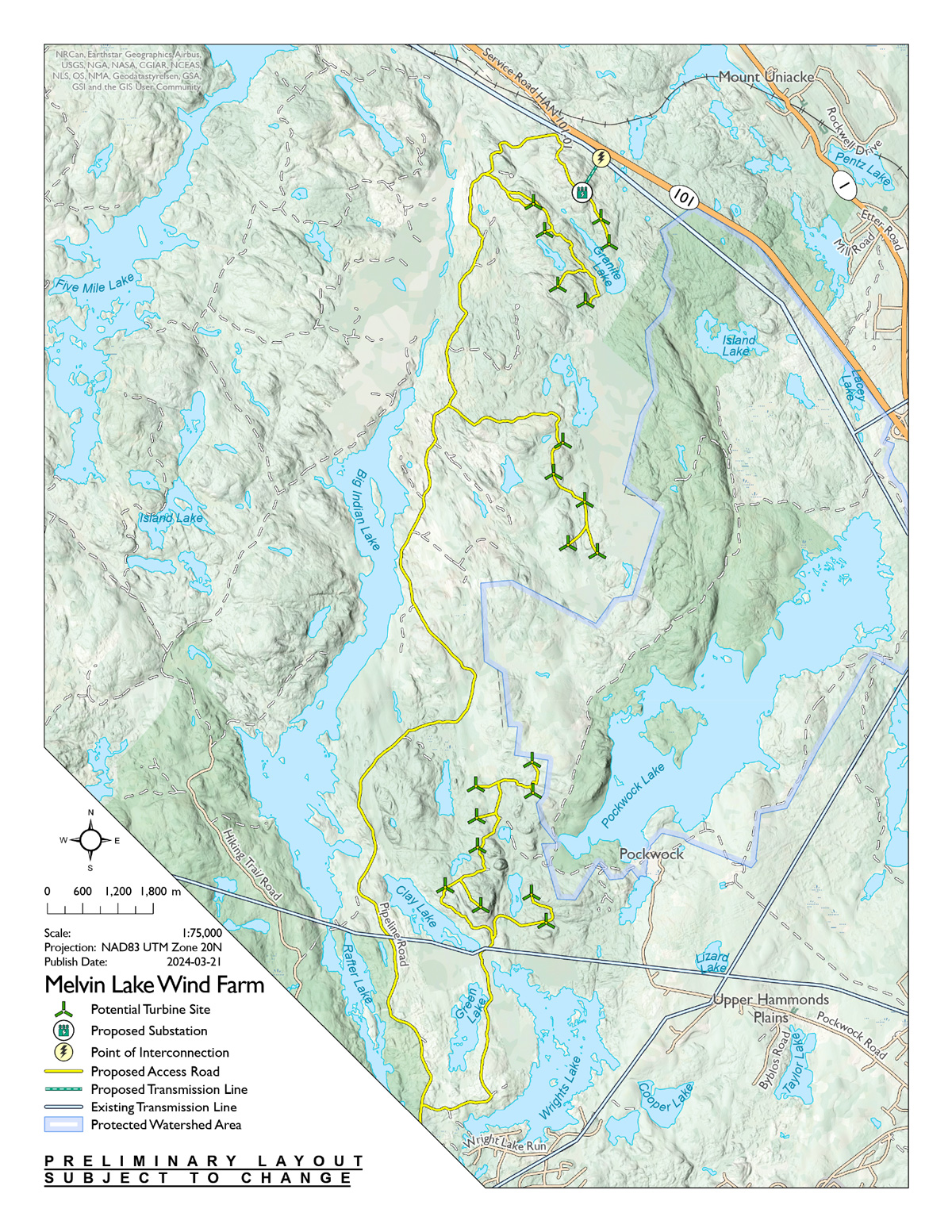
The Project would place 20 wind turbines on private land south of Highway 101 and west of Pockwock Lake. The Project area of interest was initially selected due to low grid connection cost and proximity to Halifax, favourable wind speeds, an existing network of forestry roads, land topography, grid capacity and the ability to adhere to and exceed company, municipal and provincial setback guidelines.
Download
| Timeline | Activity |
| Ongoing | Engagement with Community, First Nations and Government |
| Winter 2027 | Project submission into the NS Green Choice Program Procurement |
| Spring 2027 | Notice of Power Purchase Agreement award if Project is selected in the procurement |
| 2028 - 2030 | Engineering and Construction |
| 2030 | Targeted Commercial Operation Date |
Consultation will continue through the life of the Project with stakeholders and First Nations. Currently, we are in the planning stage. There will be ample opportunity to ask questions, make comments and provide input during the Project design and environmental assessment stage.
We will continue to provide Project updates and correspond on a timely basis, through our website, open houses, mail-outs, personal meetings and expanded communication channels. Our objective is to facilitate open, honest and respectful discussion with all those interested in the Project.
ABO Energy (formerly known as ABO Wind) successfully develops and builds wind and solar farms as well as battery storage and hydrogen projects. Founded in 1996, the Germany-based company has realized 6.6 gigawatts of renewable energy capacity to date and has built around half of them. The annual investment amounts to one billion euros. On four continents, our teams work with enthusiasm on the development, planning, financing, construction, operational management, and maintenance of plants for a sustainable energy supply.
ABO Energy Canada was founded in 2017, with offices in Calgary, Halifax, and St. John’s. At ABO Energy, renewables are our DNA.
Third-party studies have confirmed that wind turbines typically offset greenhouse gases emitted as part of their production and installation within the first year of operation. When the whole cycle of production and operations is considered, wind energy is recognized as one of the “greenest” or least carbon intensive forms of energy production.
As part of the regulatory approval process, an environmental assessment will be undertaken to understand the relationship between wind turbines and the local environment. This is a requirement of the Province of Nova Scotia. Through this analysis, our team will make the necessary adjustments to the Project to avoid or reduce potential impact on wildlife.
By using existing roads and cleared areas as much as possible, we believe that we would need to clear 3 to 4 acres per turbine.
As part of the regulatory approval process, an environmental assessment will be undertaken to understand the relationship between wind turbines and the local environment. This includes wetlands, watercourses, fish habitat and groundwater. This is a requirement of the province of Nova Scotia. Through this analysis, the Proponent will make the necessary adjustments to the Project to avoid or minimize potential impact on water resources to the extent feasible.
Depending on the turbine selected for the project, the concrete foundation for the turbine will range from 22 metres to 25 metres in diameter. Most of the foundation will be below ground and backfilled with soil.
The Project received an Environmental Assessment (EA) approval for up to 23 turbines, 161 MW in later 2024. This approval, along with other permitting requirements, is required by the Province of Nova Scotia. As part of this process, many field and desktop studies were undertaken to understand any potential impacts. An environmental assessment includes thorough review of scientific data and evidence, along with consultation with the public and NS Mi’kmaq. It looks at what effect the project will have on the environment, climate change and people, and how the proponent will reduce or eliminate impacts the project could cause. The Project EA can be found here: Melvin Lake Wind Project | Environmental Assessment | Nova Scotia Environment
The visibility of each turbine depends on the viewpoint. On the Project website there are preliminary visual simulations prepared by a third party. During development, we will ask community representatives to offer more viewpoints for more detailed visualizations.
The proposed layout and turbine technology will likely change based on stakeholder, environmental and technical input. We will update the visual and sound assessments to reflect the most up-to-date plan as part of the environmental assessment process.
A few factors contribute to the choice of wind turbines, such as the wind profile and the height of nearby vertical obstacles. We anticipate that the hub height will range from about 100 metres to 125 metres with an approximate blade length between 60 metres and 85 metres.
Aviation warning lights on wind turbines are required by Transport Canada regulations. However, the Project is exploring the feasibility of light mitigation options to reduce the visibility to those on the ground.
During development, we prepare a noise impact assessment with a map showing predicted sound emissions in relation to nearby residential properties. All proposed turbine locations currently meet sound modeling requirements. All of our planning has been done within regulated setbacks, following provincial and municipal guidelines.
There are over 75,000 operational wind turbines in Canada and United States and there are now over 100 peer-reviewed published scientific articles on the potential for health impacts living in proximity to wind turbines. Although audible sound, infrasound and low frequency noise (LFN) are emitted from wind turbines it is not at a level that causes health impacts, headaches, nausea, sleep problems and tinnitus. LFN or infrasound are a common occurrence produced from wind itself and other human sources including road traffic, refrigerators, air conditioners, farm machinery, and airplanes.
Infrasound can be defined as sound waves with frequencies below the lower limit of human hearing. We will design the Project to meet Nova Scotia’s regulations regarding audible sound criteria.
Humans are exposed to infrasound on a regular basis from several natural and engineered sources, at levels that generally exceed those produced by wind turbines. Additional information can be found at the Health Canada Wind Turbine Noise Study website: pamphlet-brochure-eng.pdf (canada.ca)
We respect that some individuals may have concerns regarding health. The Project will be designed to meet or exceed all provincial regulations and guidelines currently in place to protect human health.
Health Canada with Statistics Canada and other external experts conducted a Community Noise and Health Study on wind turbines. The results, which were released in 2014, indicated that wind turbine noise was not linked to self-reported medical illnesses and health conditions. Additional information can be found at the Health Canada Wind Turbine Noise Study website: pamphlet-brochure-eng.pdf (canada.ca)
This renewable energy project will involve up to 20 wind turbines, producing an estimated 115.5 megawatts of green energy – enough to power more than 25,000 homes annually!
Several factors contribute to the size of a project such as Melvin Lake Wind
ABO Energy strongly values positive community relations. It will be our practice to provide updates to the project at key milestones ensuring that First Nations and those living and working in the area have opportunities to discuss and comment through a variety of methods, including, phone, email, video meeting, and face-to-face meetings.
We want to hear from the community. Please contact us anytime through the form at www.melvinlakewind.ca.
ABO Energy Canada acknowledges that the proposed project is located in Mi’kma’ki, the ancestral, unceded territory of the Mi’kmaq people. We are grateful for the Treaties of Peace and Friendship with the Mi’kmaq people, which set out long-standing promises, mutual obligations, and benefits for all parties involved. We have active ongoing communication with First Nations communities.
ABO Energy will send out updates on the Project via mail to addresses located in the areas surrounding the proposed Project. Updates will also be added to our website (www.melvinlakewind.ca) so that those outside of the immediate Project area can remained informed. Advertisements in the local paper will also announce the release of these updates.
Thank you for those who have already participated in the Project’s volunteer Community Liaison Committee (CLC) in past – we will be in touch with you when we are looking to plan our next. We’re still welcoming additional volunteers to share input, community perspectives, and guidance to help shape the Project. Once up and running again, the CLC will meet regularly to discuss project plans, identify issues, and explore solutions. If you’d like to participate, please email heidi.kirby@aboenergy.com or contact 902-329-9907.
The aim of the open house is to provide Project information and respond to questions or concerns in a safe and comfortable environment. Through experience, we have found that one- on-one or small-group conversations with posters allows people to learn about the project at their own pace, and to voice their questions and concerns without feeling the pressure of an audience.
Please send questions and/or concerns to us through the form on this website. We will continue to update visualizations, maps and other information on the website as the project evolves.
Visit www.putwindtowork.ca to learn more about onshore wind energy in Nova Scotia. To learn more about wind energy in Canada, visit the Canadian Renewable Energy Association website: Canadian Renewable Energy Association - Wind. Solar. Storage. (renewablesassociation.ca)
ABO Energy and any other companies or contractors involved in this Project must have safety at top of mind and follow all safety and emergency response protocols, from site visits to construction and operations. As the Project developer, ABO is creating a Project-specific Emergency Management Plan (ERP) and completing Field Level Hazard Assessments when conducting onsite work. The ERP will be informed by industry best-practices, ABO’s global and Canadian expertise in developing wind farms, and local emergency responders. ABO has had initial outreach with local fire personnel and will further consult first responders to ensure alignment with local resources. The ERP will be comprehensive and include details about on-site and offsite resources to assist in suppressing and containing a fire on the Project site, along with other safety plans (and mitigation).
The Project will utilize existing access roads along with some new access roads as part of this Project. ABO Energy will work to ensure adequate emergency access, including identified egresses for the Project site are incorporated and shared as part of its Project safety planning.
Turbine fires are uncommon with an estimated probability of a wind turbine fire ranging between one in 2,000 to one in 7,000, according to Firetrace International (p.3). Modern turbines have smoke detection equipment installed within the nacelle, “the rectangle”, at the top of the tower. While the Proponent has not finalized the turbine model for the Project, it expects that the selected turbine will have smoke detection equipment. ABO recognizes these risks, no matter how small, are important to plan for and be prepared for – safety is paramount during all aspects of the Project’s construction and operational life.
There are many factors to consider in siting wind turbines, such as the following: our ability to keep setbacks to at least 1,000 metres from homes; the wind resource; environmental features; access to transmission lines; and the ability to access and build turbines at the location.
A 6-metre-wide road will be built for both construction and operations. New and existing road intersections will be widened temporarily for turbine delivery and reclaimed once turbine installation is completed.
The lifecycle of a turbine is typically 20 to 30 years. The life expectancy of this Project will be subject to the requirements set out by Nova Scotia Power within the Power Purchase Agreement, which we expect to be 25 years.
The current Project schedule is subject to change depending on the criteria in the upcoming Request for Proposals (Green Choice Program).
The proponent will have a local operations team, including an operations manager who will be responsible for the wind farm’s maintenance program. Depending on the project’s turbine contract, the original equipment manufacturer (OEM) may be responsible for turbine maintenance and any required repairs for an agreed term of the project life. Local contractors are typically hired for maintenance items, such as road maintenance, snow removal, equipment service, etc.
Power generated from this project will feed into the Nova Scotia grid.
Project planning will be done to minimize restrictions on land use. Typically, most activities underway before construction of a wind site can continue afterwards.
For confidentiality reasons, all we can say is we propose contracts that are typical and competitive within this region and within the renewable energy industry.
Under the rare circumstance of a renewable energy company going bankrupt, the inherent value in the operating wind facility remains. Typically, the major investors in the project will buy out the bankrupt company to ensure their investment is protected. A bankruptcy would not typically affect the operations of a wind facility, as the investment community understands the economic value of an operating electricity generation asset.
Project land contracts and regulatory approvals will contain requirements for reclamation and decommissioning. The Project will also complete a salvage value study before decommissioning turbines – to evaluate potential costs of salvaging compared to decommissioning costs. ABO Energy anticipates the salvage value of recovered metals (for example, copper, steel, rare earth metals) will cover a portion of decommissioning costs.
ABO Energy Canada has contracts in place with landowners who will have infrastructure on their property.
The Project will adhere to all required setbacks from the Province of NS and the Municipality. The province’s latest regulations include:
A professional sound study will be shared publicly and the results incorporated into our site layout to maintain compliance before any final turbine locations are determined.
Studies have been conducted on property sale data in and around wind farms in Canada, the United States, and internationally. Data gathered cannot support or disprove the impact on property values.
In Ontario, the Municipal Property Assessment Corporation (MPAC) examined assessments of properties located at 1 kilometre, 2 kilometres and 5 kilometres from wind turbines. The studies found that for 2012 and 2016, there were no conclusive findings on the prices of residential properties resulting from the proximity to a wind turbine. See https://www.mpac.ca/en/PropertyTypes/SpecialStructuresProperties/Windturbinesnearorproperties
The Project will bring significant economic opportunities to the region.
Wherever possible, local labour, services, and materials will be prioritized during development, construction, and operations - supporting local businesses, ports, and creating employment opportunities. These activities are expected to generate both direct and indirect benefits for nearby communities, including First Nations.
The Project is expected to create approximately 80 jobs during development and construction, and 1–3 long-term operational roles. Opportunities may include labourers, operators, truck drivers, safety officers, crane operators, tradespeople, wind turbine technicians, engineers, and administrative support roles.
Local contracting opportunities may include tree clearing, foundation work, road construction, electrical work, and more.
If you are a Vendor interested in providing your goods and/or services to ABO Energy Canada Ltd. we ask that you submit your company information via our ‘Supplier Registration Form’ located here:
What questions do you have about Melvin Lake Wind? Please do not hesitate to contact us.